Chapter 5 — Attention Variants: GQA, MQA & MLA
“The memory bottleneck in LLM inference isn’t compute — it’s the KV-cache. Different attention variants offer different tradeoffs between quality, memory, and throughput.”
The KV Bottleneck
In standard Multi-Head Attention (MHA), every head has its own Q, K, and V projections. During autoregressive generation, we cache K and V for every head at every layer for every past token. This KV-cache grows linearly with sequence length and is often the dominant memory cost at inference time (see Chapter 17 for the full deep dive).
For LLaMA-3-8B (MHA, 32 heads, d_k=128, 32 layers, FP16):
\[\text{KV-cache} = 2 \times 32 \times 32 \times 128 \times T \times 2\text{B} = 524{,}288 \times T \text{ bytes}\]At T = 8192 tokens: ~4 GB per request, just for KV-cache.
The key insight: not all heads need their own K and V. Query heads are diverse and important, but key and value heads can be shared without much quality loss.
Multi-Query Attention (MQA)
MQA (Shazeer, 2019) is the most aggressive sharing strategy: all query heads share a single K and V projection.
KV-cache memory reduction: H× smaller (32× for 32-head models).
Trade-off: slightly lower quality than MHA, especially on harder reasoning tasks. Used in PaLM, Falcon, StarCoder.
Grouped-Query Attention (GQA)
GQA (Ainslie et al., 2023) is the compromise: query heads are divided into G groups, and each group shares one K and V head. When G = 1, GQA = MQA. When G = H, GQA = MHA.
GQA in Practice
| Model | Query Heads (H) | KV Heads (G) | Queries per KV | KV Reduction |
|---|---|---|---|---|
| LLaMA-2-7B | 32 | 32 | 1 | 1× (MHA) |
| LLaMA-2-70B | 64 | 8 | 8 | 8× |
| LLaMA-3-8B | 32 | 8 | 4 | 4× |
| LLaMA-3-70B | 64 | 8 | 8 | 8× |
| Mistral 7B | 32 | 8 | 4 | 4× |
| Gemma 2 9B | 16 | 8 | 2 | 2× |
| Qwen 2.5 7B | 28 | 4 | 7 | 7× |
GQA Implementation
The key change from MHA is in the projection sizes and a repeat_interleave or expand to broadcast KV heads to match Q heads:
1
2
3
4
5
6
7
8
9
10
11
12
13
14
15
16
17
18
19
20
21
22
23
24
25
26
27
28
29
class GroupedQueryAttention(nn.Module):
    def __init__(self, d_model, n_heads, n_kv_heads):
        super().__init__()
        self.n_heads = n_heads
        self.n_kv_heads = n_kv_heads
        self.n_rep = n_heads // n_kv_heads  # queries per KV head
        self.d_k = d_model // n_heads

        self.W_q = nn.Linear(d_model, n_heads * self.d_k, bias=False)
        self.W_k = nn.Linear(d_model, n_kv_heads * self.d_k, bias=False)  # smaller!
        self.W_v = nn.Linear(d_model, n_kv_heads * self.d_k, bias=False)  # smaller!
        self.W_o = nn.Linear(d_model, d_model, bias=False)

    def forward(self, x, mask=None):
        B, T, _ = x.shape

        Q = self.W_q(x).view(B, T, self.n_heads, self.d_k).transpose(1, 2)     # [B, H, T, d_k]
        K = self.W_k(x).view(B, T, self.n_kv_heads, self.d_k).transpose(1, 2)  # [B, G, T, d_k]
        V = self.W_v(x).view(B, T, self.n_kv_heads, self.d_k).transpose(1, 2)  # [B, G, T, d_k]

        # Expand KV heads to match Q heads: [B, G, T, d_k] → [B, H, T, d_k]
        K = K.repeat_interleave(self.n_rep, dim=1)
        V = V.repeat_interleave(self.n_rep, dim=1)

        # Standard SDPA
        attn = F.scaled_dot_product_attention(Q, K, V, is_causal=True)  # [B, H, T, d_k]

        out = attn.transpose(1, 2).contiguous().view(B, T, -1)
        return self.W_o(out)
Parameter savings: W_k and W_v go from [d_model, d_model] to [d_model, G × d_k]. For LLaMA-3-8B (d=4096, H=32, G=8): each KV projection drops from 4096×4096 to 4096×1024 — 4× smaller.
Multi-Latent Attention (MLA)
MLA (DeepSeek-V2, 2024) takes a fundamentally different approach: instead of reducing the number of KV heads, it compresses the KV representations into a low-rank latent space.
The key advantage: at inference time, you only cache the compressed latent [B, T, d_c] instead of full K and V tensors. If d_c = 512 and d_model = 4096, this is an 8× compression of the KV-cache — even better than GQA in some configs.
DeepSeek-V2 also combines this with a decoupled RoPE where a separate small projection handles positional encoding, allowing the main KV compression to be position-independent.
Sliding Window Attention
Sliding Window Attention (Mistral, 2023) limits each token’s attention to a local window of W previous tokens instead of the full sequence. Outside the window, attention scores are masked to −∞.
- ✓ · · · ·
- ✓ ✓ · · ·
- ✓ ✓ ✓ · ·
- ✓ ✓ ✓ ✓ ·
- ✓ ✓ ✓ ✓ ✓
- ✓ · · · ·
- ✓ ✓ · · ·
- ✓ ✓ ✓ · ·
- · ✓ ✓ ✓ ·
- · · ✓ ✓ ✓
KV-cache becomes fixed at W entries per head instead of growing with T. Information beyond the window can still flow through stacked layers (layer L attends to W, layer L+1’s window sees those representations, effectively reaching 2W tokens back).
Mistral 7B uses W = 4096 with alternating sliding-window and full-attention layers.
Comparison Summary
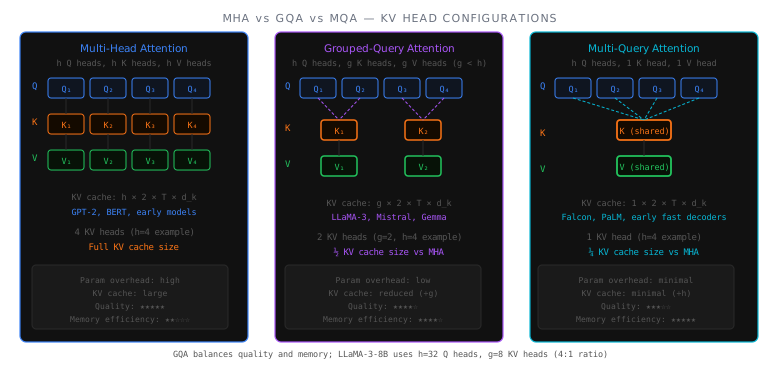
| Variant | KV per Head | KV Heads | Cache Size | Quality | Models |
|---|---|---|---|---|---|
| MHA | Full | H | 2 × L × H × d_k × T |
Best | GPT, LLaMA-1 |
| MQA | Full | 1 | 2 × L × 1 × d_k × T |
Lowest | PaLM, Falcon |
| GQA | Full | G | 2 × L × G × d_k × T |
Near-MHA | LLaMA-2/3, Mistral |
| MLA | Compressed | — | L × d_c × T |
Near-MHA | DeepSeek-V2/V3 |
| SWA | Full | H/G | 2 × L × H × d_k × W |
Good (local) | Mistral, Gemma |
What’s Next
Now that we understand the attention mechanisms inside transformer blocks, we’ll see how these components assemble into complete decoder-only models — the dominant architecture for modern LLMs.
← Previous: Chapter 4 — SDPA & Multi-Head Attention · Next: Chapter 6 — Decoder-Only Models →
Last updated: April 2026